

Rest
Every hard area needs a bench nearby

In 2013 I took a tour of the Holocaust Museum in Washington D.C. At the time, cameras were not allowed inside (a rule meant to preserve the solemnity of the experience, and one I agree with). To say it was impactful is an understatement. The scale of devastation is difficult to grasp even with seventy years of history separating us from it.
But one standout memory was a bench.
I spotted it early in the tour, a simple school bench with joinery that caught my eye. I studied it as much as the vibe in the room allowed, which wasn’t much. Later, I found I couldn’t reconstruct it mentally. The picture in my mind was incomplete, details garbled and shifting, like a dream half-remembered. Periodically, it’d resurface, but never completely clear.
Years later, Jameel Abraham started building a bench design from the Amana villages, which became a FWW article, and my memory flashed immediately back to that bench. This was the joinery puzzle solved (or surely its close cousin)
At Handworks ‘23 I sat on one, and understood how pleasant it is. Brad Holley and I agreed we were both building one when we got home. He got there sooner.
When faced with widespread suffering, past or present, it can seem like the wrong time to be sweating joinery details. Perhaps, it may actually be the right time. Not as a way of burying your head in the sand, but because making things real, and reflecting on the craftsmanship before us, is one of the ways we stay tethered to what matters and connect the dots of our own story. To most people, this bench looks pretty simple. That’s kind of the point; the complexity is there for those that want to dive deeper.
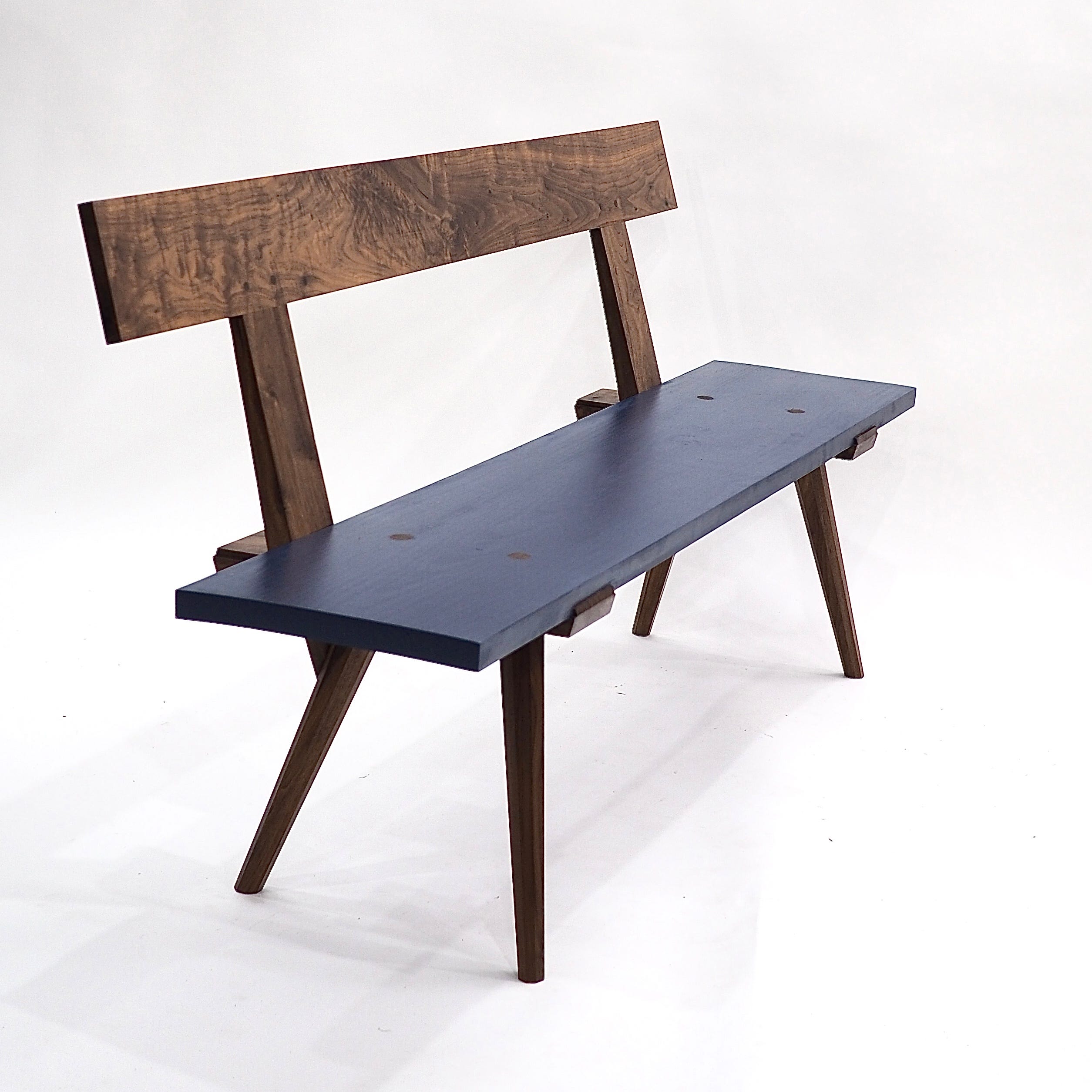
For the record, it’s a great bench to build if joinery excites you. It’s a sleeper, which is my favorite kind of hot rod, she’s got it where it counts. Sliding dovetails with pierced legs, angled through tenons, draw bored mortise & tenons, round wedged dowels for the knockdown back that leans against the leg for more support, a whole kitchen sink of joinery going on inside something that reads, to the casual eye, as a plain seat. It’s a blank canvas, open to embellishment in many directions and styles.
In this iteration, I departed from the FWW plans by octagonalizing the legs, leaving the dovetail baton proud and beveled, sculpting the rear joinery together, and of course painting the seat. I’d used southern yellow pine for the seat which does contrast walnut nicely, but after experimenting with making milk paint (a story for another post) ended up reusing some deep galaxy blue paint, lending a quiet harmony to the figure in the back. I can see returning to this form repeatedly: a quote carved along the back in the whimsical style of Dave Fisher, some Celtic or Urnes scrollwork, a kumiko inlay. The form invites experimentation.
Maybe this is what gives me hope for the future, in a world perennially on fire. That people past and present amid suffering and struggle, continue to make interesting and beautiful things to endure times both good and bad.


Beautiful work! I love that bench. I need to make one too. And what a great story that led to yours!
Funny side story, I made a custom seat drilling guide for Jameel to put this bench into production a few months before Handworks 2023. They are still using it today. The guide references off the front of the seat and the inside of each of the dovetail battens to drill and ream the seat mortises one pair at a time. Since I only mocked up the joints to make the guide, I never actually made the full bench.
Also, “It’s a sleeper, which is my favorite kind of hot rod, she’s got it where it counts.” #relatable